
A useful golf cap brief describes the shape someone will wear, rather than relying on a phrase such as “standard golf fit”. Two caps can share a six-panel layout and a curved brim while sitting quite differently on the head. Crown depth, front support, rear adjustment and the visor all need a clear reference.
When discussing a project with a golf cap manufacturer, use the Custom Golf Cap Buying Guide to organise the wider specification. This article focuses on translating the intended silhouette into details that can be reviewed on a sample.
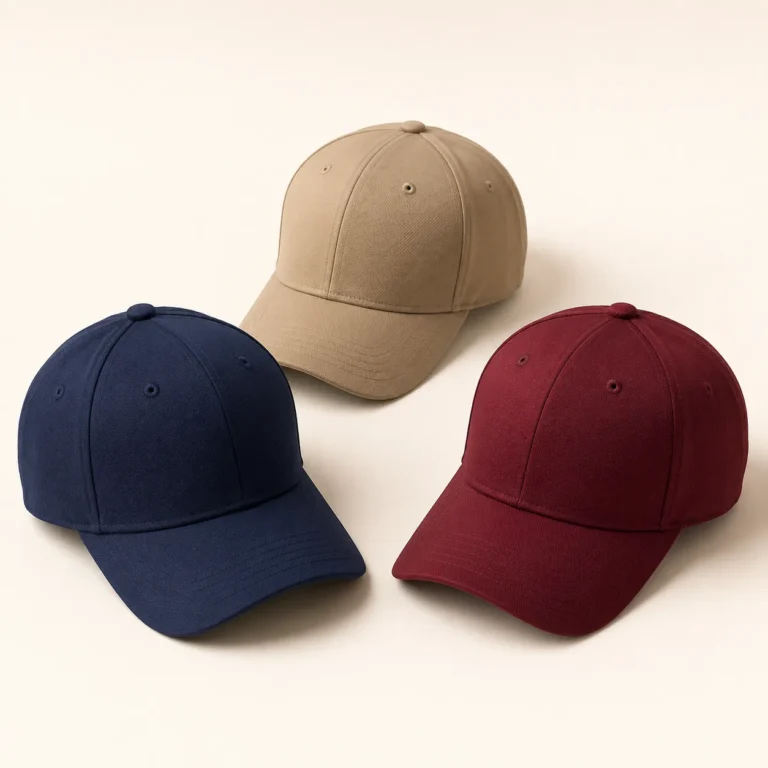
Show the intended wearing position
Start with a side view of a cap worn in the intended position. Indicate where the lower edge sits above the ears, how much space remains over the head and where the front meets the forehead. An unworn product photograph helps explain appearance, but it cannot demonstrate that fit.
Include a physical reference or a measurement drawing where available. Mark the measuring points and the condition in which each measurement is taken. A flat measurement and a measurement following a curved seam are different instructions, even if both are called “crown height”.
Connect panel layout with front support
Specify the panel arrangement, front seam and support construction together. A defined front and a softer front produce different silhouettes. Show the desired result from the front and side instead of asking only for a “premium” or “sporty” crown.
For a named market example, Titleist describes its Tour Performance Hat with a structured front panel and a standard curved bill. That describes Titleist’s own product; it is a reference for clear feature language, not a Wenext Caps specification or affiliation.
Draw the visor as part of the silhouette
Record the visor projection, width, corner shape and preferred curve. Identify where each measurement begins. Include the underbrim colour, edge finish and topstitching layout when these affect the design.
Review the visor attached to the proposed crown. A brim that looks balanced on one crown may appear too broad or too prominent on another. Check the front centre line and compare left and right views. If buyers expect to wear sunglasses, include them in the fitting review and note any contact with the brim or cap edge.
Choose how the cap reaches the required fit
Decide whether the project uses an adjustable closure, a stretch-fit arrangement or separate fitted sizes. For adjustable golf caps, show the closure type, rear opening, strap finish and intended adjustment range. Check the cap at relevant settings; a closure that fastens is not evidence that the whole crown fits every intended wearer.
A fitted programme needs its own size chart and sample coverage. Keep the size designation, finished measurements and buyer-approved tolerances connected. Do not transfer another brand’s size label to a new pattern without checking the actual fit.
Keep the interior in the construction drawing
The sweatband, seam tape, label positions and closure attachment belong in the same brief. Mark the sweatband width and seam locations, and review whether labels sit clear of the contact area. If a specific band material or performance property matters, identify it separately from appearance.
Also mark eyelet positions and other openings. Confirm their spacing and edge finish on the sample. Their presence alone does not establish a tested cooling or breathability result.
Record a construction decision before adding variations
Give the base construction a reference code and revision date. List the chosen shell, support, visor insert, sweatband, closure and measuring method beside the approved views. Separate accepted details from questions still awaiting a sample.
Then identify which colourways or logo versions share that base and which introduce a construction change. This makes it easier to discuss a revision without accidentally carrying it into every version of the range.
Review the Wenext Caps golf cap product page, then send the construction reference and project breakdown. Include the intended use, quantities and requested delivery location so the proposed specification can be discussed in context.