
A five-panel camper hat intended for travel needs a brief that describes how it will be worn and carried. A city-day cap, a running cap and a cap for a long walk may share a visual reference while leaving different questions about fit, ventilation and the rear fastening.
Tell the camper hat supplier which situation you are designing for. Use the 5-Panel Cap Buying Guide to connect that use with the construction choices. This article focuses on the details to review around the head, inside the crown and at the closure.
Write a short use description before choosing features
Describe the intended wearer, activity and wearing position. Include relevant interactions, such as carrying the cap in a bag or wearing it with other equipment. Identify which of those situations the sample review needs to represent.
A useful brief can be specific without making an unsupported performance claim. For example, it can request a particular side-panel arrangement or a strap that is easy to locate and adjust. Any measurable requirement should be defined separately, with the evidence needed to support it.
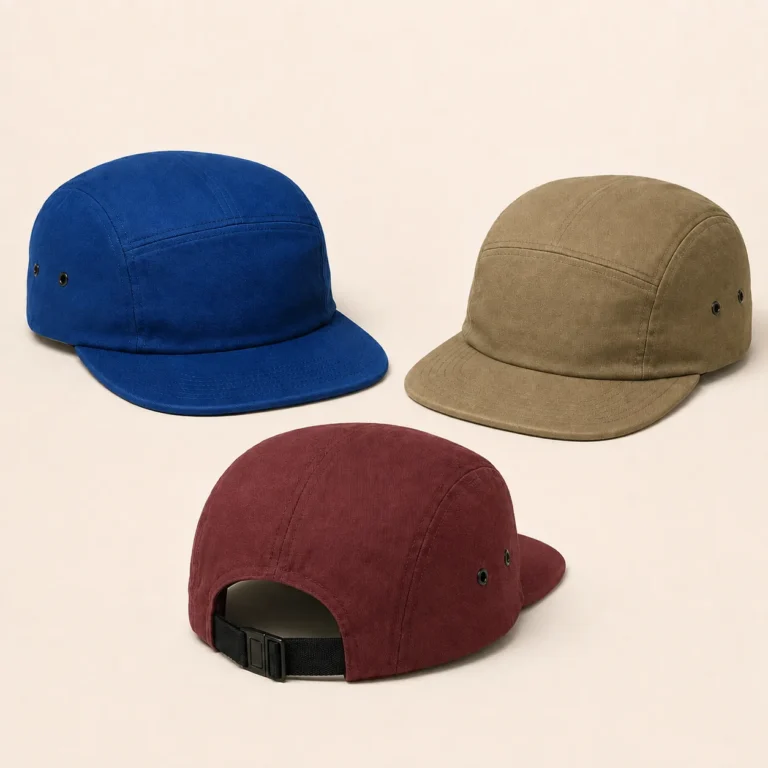
Review fit with the intended closure setting
Agree the wearing setup and relevant measurements. Look at crown depth, the side position and the rear opening while the cap is worn. Record the setting used for the comparison so a second sample can be reviewed consistently.
Where an adjustment range is part of the brief, check the relevant settings on the proposed construction. A rear strap may change the circumference without resolving a crown-depth concern. Describe the fit issue at its location rather than requesting a smaller or larger cap without further detail.
Describe ventilation as a construction choice
Mark the requested mesh panels, eyelets or other openings on the drawing. Identify their positions and proposed materials. Review the inside components too, since the complete arrangement is what the wearer receives.
For an example of product-specific feature descriptions, Patagonia’s Duckbill Cap page identifies mesh in its own cap construction. Use such a reference to explain a feature under discussion. It does not establish the performance of another cap or make a photograph evidence of a tested property.
Check the whole fastening arrangement
Name the proposed buckle or clip, strap material and strap-end arrangement. Show how the fastening sits beside the rear opening and inside band. Review access to the adjustment, the loose end and any contact areas on the assembled cap.
If the sample uses a temporary fastening, note that limit in the approval. A visually similar component may have a different size, shape or handling. Identify the intended version and agree which fit or use checks need to be repeated when it is fitted.
Bring the inside details into the sample discussion
Identify the sweatband, seam treatment, labels and any front support. Check the positions where these pieces meet on the sample. If a label or trim is changed, review its relationship to the inside band and fastening rather than treating it only as a graphic file.
Keep wear observations separate from a formal material test result. Record what was observed, in which setup and on which sample. If the project calls for a particular drying or moisture-management property, ask the responsible technical party to define the relevant requirement and evidence.
| Area | Reference to review |
|---|---|
| Intended use | Wearer, activity, carrying situation and relevant interactions |
| Fit setup | Wearing position, measurements and closure settings |
| Ventilation layout | Marked openings, materials and inside components |
| Fastening | Selected component, strap handling and rear contact areas |
Review carrying and unpacking as a separate question
If the cap needs to fold or compress for travel, define that handling and the acceptable condition afterward. Use the camper-cap packability review rather than assuming the feature follows from the five-panel category.
Discuss the construction through the Wenext five-panel cap product page. Send the use description, marked ventilation layout and closure references through Contact Wenext Caps so the sample can address the intended situation.