
A baseball cap brief is easier to discuss when the buyer and sample team use the same words for its parts. Crown shape, panel count and front support describe different decisions, even when they appear together in one cap. Use construction terms to identify the feature being reviewed, then add the actual dimensions and component references.
The Baseball Cap Buying Guide connects these choices to sampling and ordering. This glossary explains the main parts of a baseball cap and how they relate to the finished product.
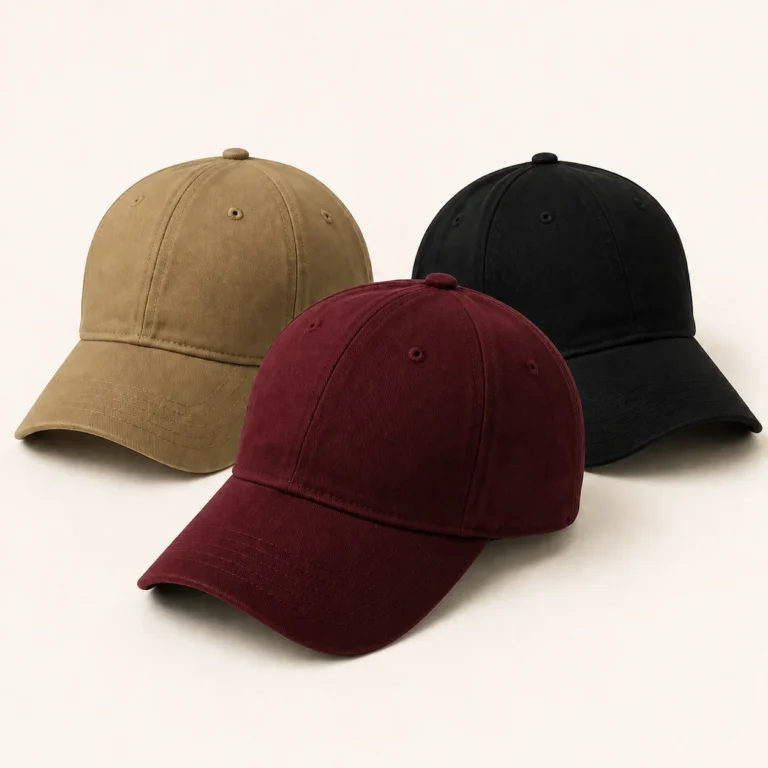
Crown and panels
The crown is the part covering the head. Panels are the pieces forming it, with seams joining them. Panel count describes that arrangement; it does not by itself specify crown depth, head-opening size or the final worn profile.
For a development brief, show front, side and rear views and identify the relevant dimensions. The six-panel baseball cap article explains how a familiar panel arrangement still needs its own shape and fit references.
Front support and shell fabric
The shell is the visible outer material. Front support describes the reinforcement arrangement used behind the relevant crown area. A structured or softer front needs an identifiable construction reference rather than a fabric name alone.
CottonWorks’ woven fabric resource explains fabric construction terms. Those cloth descriptions and the cap’s support arrangement are separate parts of the brief. Review their combination on the assembled sample.
Sweatband and seam tape
The sweatband runs around the interior head opening. Its material, dimensions, joins and attachment belong in the fit and finishing review. It should not be identified only by an assumed function drawn from its name.
Seam tape covers or finishes relevant interior seam areas in the proposed construction. Record the actual arrangement, material and any branding or label relationship. Check how the interior components meet rather than approving each loose trim without an assembled view.
Visor, brim or bill
These terms are often used for the projecting front part of the cap. The brief should identify its width, projection, insert, covering materials and accepted curve or flat profile. A name such as pre-curved does not describe every dimension.
Review the visor-to-crown join and the overall profile. Keep the accepted shape reference with the measurement method, since a curved component can be measured in more than one way. Record the intended stitch rows and edge finish where they are part of the design.
Rear opening and closure
The rear opening is the shaped area at the back where the chosen closure may sit. The closure is the actual fastening or adjustment arrangement. Identify matching components, attachment points and the accepted strap or tail position.
The adjustable closure review explains why physical strap travel and approved wearing range need separate records. A fitted cap uses a different size arrangement, so an adjustable-cap description should not be applied automatically.
Eyelets, top button and labels
Eyelets and the top button are visible construction details whose material, colour, dimensions and placement can be specified. Check them against the accepted reference rather than treating every cap’s details as standard.
Labels, decoration and packing add further item-specific information. Keep their artwork and placement references connected to the cap version. For a project discussion, use the Wenext Caps baseball cap product page, or send the cap construction brief with annotated views, materials, measurements and quantities.