
A fitted baseball cap supplier review should collect evidence for the product you intend to order. Broad claims about quality or experience are less useful than a sample and record that show how the proposed size system, construction and artwork will be handled.
Use the Fitted Cap Sizing and Buying Guide to define the brief first. Then use the evidence review to identify what is demonstrated, what is provisional and which questions remain open.
For a broader construction comparison, read the Baseball Cap Buying Guide or review the baseball cap product page when your brief includes other cap constructions.
Confirm who is responsible for the order
Identify the contracting and invoicing entity, the production location relevant to the proposal and the team responsible for development and approvals. Ask how responsibilities are divided if an operation is handled elsewhere.
Keep those answers attached to the actual proposal. A workshop photograph can help explain an operation, but it does not by itself establish who will make the buyer’s goods or which party is accountable for the agreed scope.
Request samples relevant to your size and construction
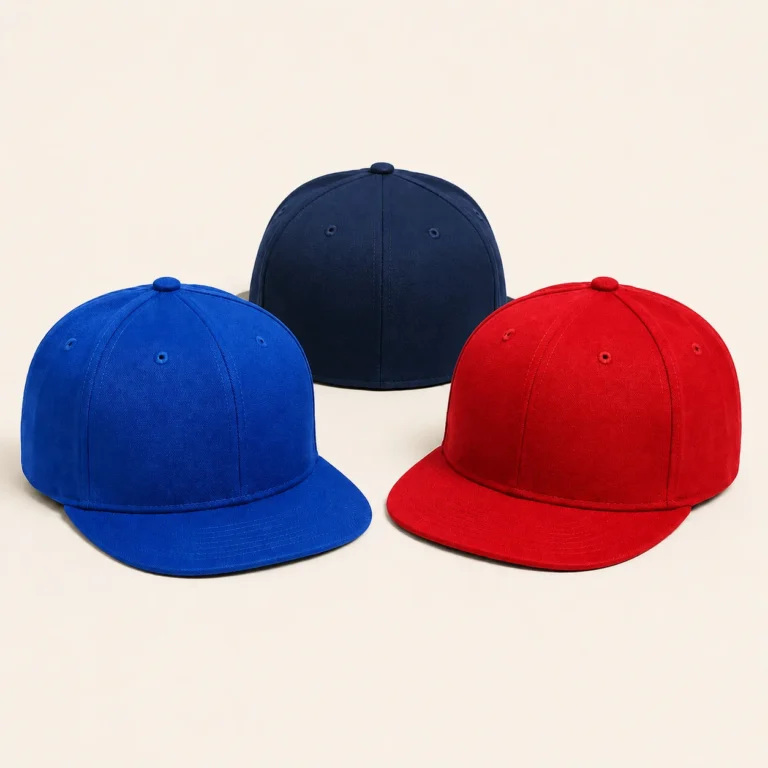
Ask which sample demonstrates the proposed fitted construction, crown shape, visor and inside finish. Identify whether it uses the intended materials and decoration. A nearby style can be useful for discussion when its differences are clearly stated.
Review how the supplier proposes to develop and approve the size set. The fitted size-set guide provides prompts for checking the range rather than relying on one attractive middle-size sample.
Look for a repeatable specification record
Ask how the supplier identifies measurement points, size values, material references and sample revisions. Review whether the response distinguishes the accepted file from proposals and earlier versions. The record should make an approval understandable to the next team handling the work.
The OEM fitted technical-file guide explains the information to compare. If a supplier proposes a different method or component, record the difference and its review status instead of treating it as an accepted substitution.
Check decoration and label evidence at actual size
Review a decoration trial that represents the intended fabric, panel construction and finished dimensions. Check fine lettering, placement and inside finish. Identify whether an example is a proposed method or an approved result for your order.
For labels and hangtags, ask for the exact copy and variable-data assignments to be reviewed. The private-label trim guide helps connect the physical proof with size labels, item codes and attachment positions.
Verify any claim that matters to the brief
If certification or another documented claim is part of the requirement, request the relevant evidence. Check the named entity, validity and scope against the product and operation being discussed. A claim about one component should not be expanded without supporting evidence.
For example, the official OEKO-TEX® Label Check allows a label number to be checked and notes that numbers are case sensitive. Use the applicable official verification route for a claim supplied in the proposal; do not infer certification from a general factory image.
Use a supplier evidence register
| Review area | Evidence and status |
|---|---|
| Accountability | Entity, relevant production location and responsible teams. |
| Product sample | Construction, materials and differences from the requested style. |
| Size development | Chart, measurement method and proposed size-set approval. |
| Decoration and trims | Actual-size trials, artwork revisions and label proofs. |
| Claim verification | Applicable documents, identity, scope and verification outcome. |
| Quality controls | Agreed criteria, inspection scope and finding-resolution process. |
| Open question | Missing evidence, responsible person and next review step. |
Connect evidence with the quotation and schedule
Check that the commercial proposal covers the specification and sample scope being reviewed. Use the fitted quotation comparison guide to identify exclusions, development charges and delivery assumptions.
Ask which approvals and material decisions must be completed before the proposed milestones can be confirmed. Keep an unanswered question open rather than converting a general response into a delivery commitment.
Agree what is needed before selection
Summarize the evidence accepted and the points still needing a sample, document or clarification. Identify the reviewer and next action for each open point. This turns a supplier conversation into a manageable project decision.
Retain the accepted references after selection. Use the fitted quality checklist to connect the approved product evidence with the requirements used for later inspection.
Common supplier-review questions
Does a similar sample prove the requested style is approved?
Identify its differences and agree which development checks remain for the actual product.
Should a certificate image be accepted on its own?
Verify the relevant identity, validity and scope through the appropriate official route and supporting documents.
What if an important answer is missing?
Record the question, evidence needed and next reviewer. Keep it unresolved until a relevant response is assessed.
Review Wenext Caps for your fitted project
Review the fitted cap product page, then send your specification and review questions to Wenext Caps. Include the sample and size-set evidence you need for a comparable proposal.